

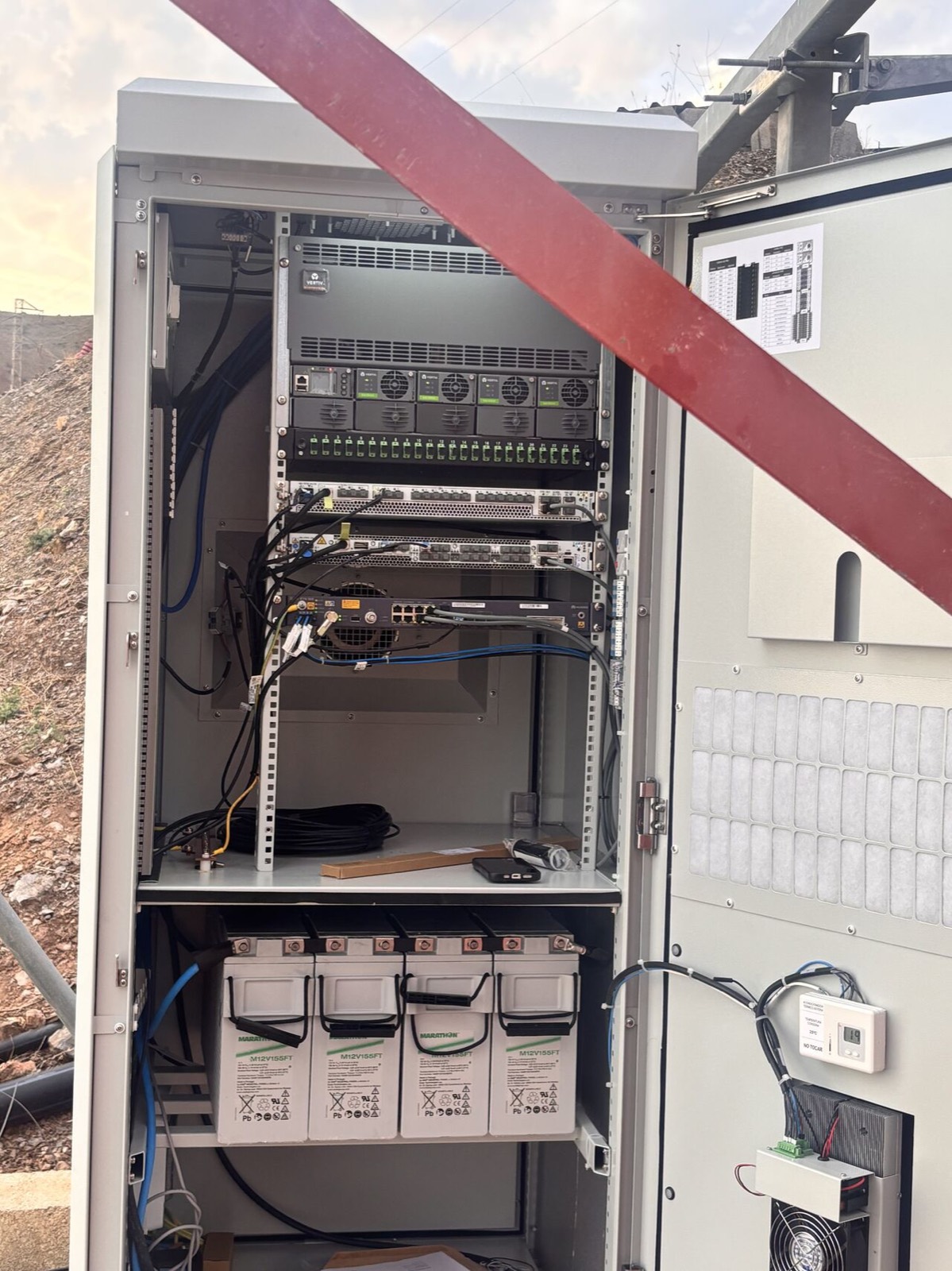
A telecom system integrator designs, deploys and maintains network infrastructure by connecting equipment and software from different vendors so that they work as a single system. Its work sits between the operator, which provides the commercial service to the end user, and the technology vendors (Ericsson, Nokia, Cisco), and it comes down to an unglamorous but critical task: getting kit from different brands to "understand each other" in production, without interrupting service for millions of people. In this article we explain exactly what it does at each stage, what sets it apart from the operator and the vendor, which risks to watch for and how to choose one.
The real problem an integrator solves
A modern telecommunications network is rarely from a single vendor. It is common to find the RAN (the radio) from one supplier, the core from another, the OSS/BSS systems from a third and the IP transport from a fourth. Each one "speaks its own language": different software versions, its own readings of the 3GPP standards or the O-RAN interfaces, timers that do not match and performance counters named in different ways.
The integrator resolves that friction. For example, in an Open RAN integration between one vendor's radio unit (O-RU) and another's distributed unit (O-DU), the open fronthaul interface (eCPRI / O-RAN 7.2x) should guarantee interoperability on paper. In practice, mismatches tend to appear in synchronisation (PTP/SyncE), in beamforming or in the physical layer. The integrator's job is to spot them in an interoperability lab before deployment, document them and coordinate the fixes with both vendors.
The difference between integrator, operator and vendor
| Criterion | Integrator | Operator | Vendor |
|---|---|---|---|
| Main role | Designs, integrates and maintains | Provides the end-user service | Produces hardware and software |
| Customer | Operators and businesses | Users and businesses | Operators and integrators |
| Multivendor | Yes, its speciality | Consumes it | No (its own brand) |
| Network assets | Usually does not own them | Owns and runs the network | Does not run the network |
| Examples | Engineering firms and system integrators | Telefónica, Vodafone, Orange | Ericsson, Nokia, Cisco |
The boundary is not always clear-cut: some vendors also offer integration services for their own equipment, and some operators keep in-house engineering teams. The independent integrator's speciality is precisely the multivendor layer, where a vendor has an obvious conflict of interest.
Core functions across the lifecycle
1. Consultancy and solution design
The integrator analyses requirements, defines the network engineering and sizes the capacity. This is where the technology is decided: 5G NSA or SA depending on the maturity of the operator's core, GPON or XGS-PON in fixed access, IP/MPLS or segment routing in transport. The aim is a scalable architecture aligned with the business KPIs (capacity per cell, target latency, committed availability).
2. Multivendor integration
This is the heart of the work: making the RAN, the core (5GC or EPC) and the OSS/BSS systems interoperate, and building the API and network orchestration layer that automates the flows. A typical source of difficulty is integrating the provisioning OSS with network elements from several vendors that expose different data models (NETCONF/YANG with their own vocabularies), which forces the development of adapters and the normalisation of information before the operator can manage it in a unified way.
3. Deployment and migration
This includes physical installation, node configuration, site rollout and, most delicate of all, traffic migrations. A hitless migration of an edge router in production requires overnight maintenance windows, a tested rollback and validation of the routing tables. Timescales range from weeks for a contained migration to several quarters for a large-scale RAN swap.
4. Operation and maintenance
This combines continuous support from a NOC, preventive and corrective maintenance, monitoring and incident management. Contracts are governed by SLAs, whose availability levels and response times are negotiated case by case: a critical core node will demand far stricter — and more expensive — commitments than a peripheral element. There is no "standard" SLA; what you sign is what you get, with its associated penalties.
Common services for operators
- Turnkey projects: delivery of the complete network, ready to operate.
- Network sharing: design and management of infrastructure shared between operators.
- Virtualisation (NFV) and software-defined networking (SDN): migration of network functions to software and programmable traffic control.
- Edge computing: computing close to the user for low-latency use cases.
- Managed services: delegated operation of the network under an SLA.
The technologies it combines
5G (NSA and SA) and RAN evolution, including Open RAN; mobile and fixed core (5GC, EPC); FTTH with GPON/XGS-PON; IP/MPLS, segment routing and optical transport; NFV, SDN and network orchestration; edge computing and cloud-native environments; IoT and massive connectivity; and network cybersecurity (segmentation, core protection and threat detection).
Risks and limits of the model (what they rarely tell you)
Delegating integration to a third party brings multivendor experience and faster time-to-market, but also trade-offs worth assessing before you sign:
- Dependence on the integrator (operational lock-in): if all the integration logic, scripts and knowledge sit with the supplier, switching partners can be slow and costly. Mitigation: require documentation, knowledge transfer and ownership of the code by contract.
- Hidden costs: migrations, scope changes and out-of-SLA hours are usually billed separately; the turnkey budget rarely reflects the total lifecycle cost.
- Diffusion of responsibility: when a service degrades there can be arguments over whether the radio, the transport or the core is to blame. A single end-to-end owner is advisable.
- Residual interoperability: open interfaces (O-RAN) reduce vendor lock-in, but they shift integration and validation complexity, which does not disappear.
Industry analysts agree that open, disaggregated architectures redistribute these risks rather than eliminating them, which reinforces the integrator's role as the end-to-end guarantor.
How to choose an integrator
- Certifications and partnerships with the vendors present in your network: they give access to support, training and roadmaps.
- Verifiable success stories on projects comparable to yours, ideally with contactable references.
- Genuine multivendor capability, not a single vendor relabelled.
- SLA model and exit clauses: availability, penalties, resolution times and, above all, conditions for reversibility and knowledge transfer.
- An in-house, traceable technical team, or one that is clearly subcontracted and auditable.
Frequently asked questions
Who is responsible if a service integrated by several vendors fails?
Ideally the integrator, as the single end-to-end owner, provided this is stated in the contract. Without such a clause, each vendor tends to point at the other, so it pays to define a "single point of responsibility" and clear escalation matrices.
How do you avoid lock-in with an integrator?
By requiring, by contract, full documentation of the integration, ownership of the scripts and configurations, knowledge-transfer plans and exit clauses with defined timescales. Open interfaces also help to reduce dependence.
Is there a standard SLA in these contracts?
No. Availability and response times are agreed according to the criticality of each element and the budget: the same supplier offers very different commitments for the core and for the periphery.
Can an operator integrate its network without an integrator?
Yes, if it has a multivendor engineering team and its own interoperability lab. It is a "make or buy" decision: many operators outsource integration to speed up deployments and focus on their commercial business.
Berintel's role
At Berintel we have spent more than 15 years deploying and maintaining telecommunications infrastructure for operators. Based in Peligros (Granada) and with a 100% in-house team, we support operators, TowerCos and mobile network operators (MNOs) on the physical side of the network: deployment of 4G, 5G and FTTH networks, installation and integration of radio and transmission equipment, civil works and maintenance. We provide nationwide coverage across Spain and we know first-hand how important a solid transport network is.
We are honest about our scope: our strength is on-the-ground deployment, installation and maintenance, carried out by our own, traceable staff. If your operator needs to deploy sites, install and integrate radio and transmission equipment or maintain its network anywhere in Spain, get in touch with our team on 958 01 27 65 or at info@berintel.es. You can also explore our business areas and services.
Content prepared by the Berintel technical team, a telecommunications and infrastructure company based in Peligros (Granada) with more than 15 years deploying and maintaining infrastructure for operators nationwide across Spain. For the market aspects and architecture trends, public industry analysis has been used as a reference.