

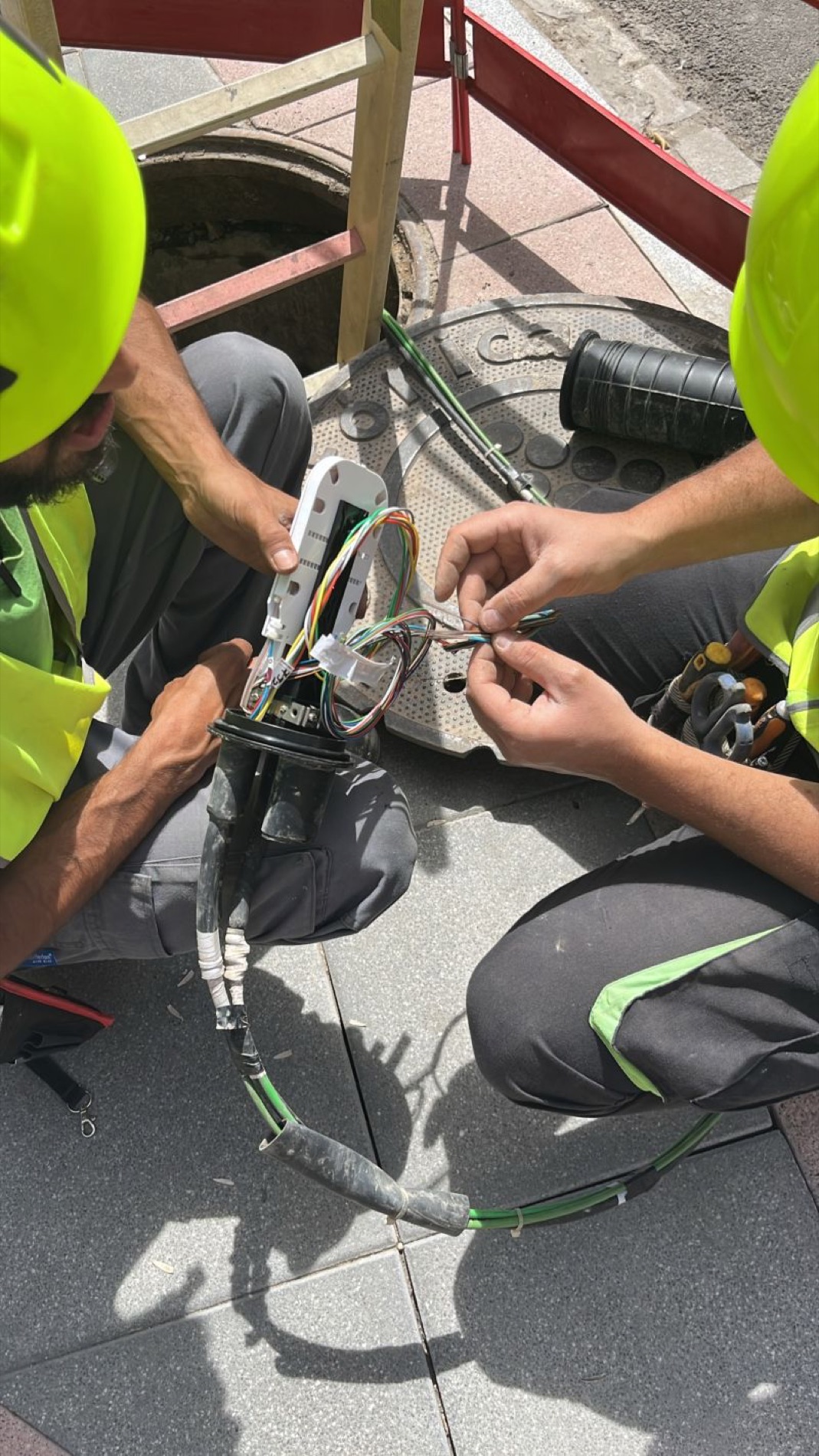
FTTH fibre optics (Fiber To The Home) is the technology that brings the optical fibre cable directly to the final service point —a home, a business or an infrastructure— with no copper sections along the way. This is what sets it apart from ADSL, which travels over the traditional telephone line, and what makes it today the fastest, most stable and most future-proof connection available. In this article we explain what FTTH fibre is, how it works, how it differs from ADSL and how a fibre network is deployed and maintained end to end.
What is FTTH fibre optics?
FTTH stands for Fiber To The Home, meaning optical fibre deployed end to end: from the operator's exchange all the way to the socket installed at the service point. Unlike other mixed architectures, an FTTH network has no copper segments or intermediate bottlenecks. The signal travels as pulses of light through a strand of glass thinner than a human hair, allowing huge amounts of data to be carried over long distances with barely any loss.
It is worth not confusing FTTH with similar acronyms. In FTTN or FTTC the fibre only reaches a node or a street cabinet, and the final stretch to the premises is still copper. Only FTTH guarantees pure fibre right up to the service point, which is why it is the standard we deploy at Berintel.
How does fibre to the home work?
The principle is simple: data is converted into light signals that travel inside the glass fibre by total internal reflection. At the customer's end, a device called an ONT (optical network terminal) translates that light back into data, which reaches the router and from there all the devices via cable or Wi-Fi.
- Light is immune to the electrical interference that affects copper.
- The signal stays intact over many kilometres without degrading.
- The available bandwidth is far greater and easy to scale up.
Thanks to this technology, the contracted speed is the speed that is consistently received, without depending on the distance from the exchange as was the case with ADSL.
Differences between FTTH, ADSL and coaxial cable
ADSL uses the copper pair of the telephone line. It works, but its speed drops sharply the further you are from the exchange, it offers very limited upload speeds and it is sensitive to interference. Coaxial cable (HFC) improves on ADSL, but it usually shares bandwidth between neighbours in the same area, which causes performance to fall during peak hours.
FTTH fibre beats both options on every front:
- Speed: far above ADSL and free of the drops seen with shared coaxial.
- Symmetry: an FTTH network can offer the same upload speed as download.
- Stability: no electrical interference and no degradation with distance.
- Latency: much lower response times, key for video calls and online gaming.
The advantage of symmetry: equal upload and download
One of the great technical advantages of fibre over ADSL is symmetry. While ADSL prioritises download and leaves upload heavily reduced, an FTTH network can deliver the same speed in both directions. This matters more and more: uploading large files, backing up to the cloud, working remotely over video conference or live streaming content all depend on a good upload speed.
With a symmetric network, sending and receiving data weigh the same: working in the cloud or remotely is no longer a limitation.
On top of this come other technical advantages of fibre: low latency, a stable connection throughout the day, greater immunity to interference and the scalability to increase speed without changing the physical infrastructure. In short, it is a technology ready for the years ahead.
Applications of an FTTH network
In residential settings, FTTH fibre lets several people stream in 4K, play online, work remotely and browse all at once without the connection suffering. In business settings, the advantages are even more decisive: symmetric upload speed is essential for cloud services, CCTV systems, remote backups, IP telephony and management applications. A stable, low-latency connection translates directly into productivity and business continuity.
How Berintel deploys and maintains fibre networks
At Berintel we have spent more than 15 years deploying and maintaining telecommunications networks and infrastructure, with a fully in-house team and headquarters in Granada. We work nationwide, across the whole of Spain, delivering the FTTH fibre roll-out and the outside plant that operators need: fibre laying and splicing, installation of nodes and joint closures, ducting, certification and network maintenance. We also carry out infrastructure and energy and renewables projects.
Berintel does not sell fibre to consumers: we design, install and maintain the network infrastructure for operators and businesses, guaranteeing deployment quality and rapid response thanks to an in-house technical team. If you need a partner for the roll-out or maintenance of your fibre network or outside plant, contact our team or discover everything we offer in our services.